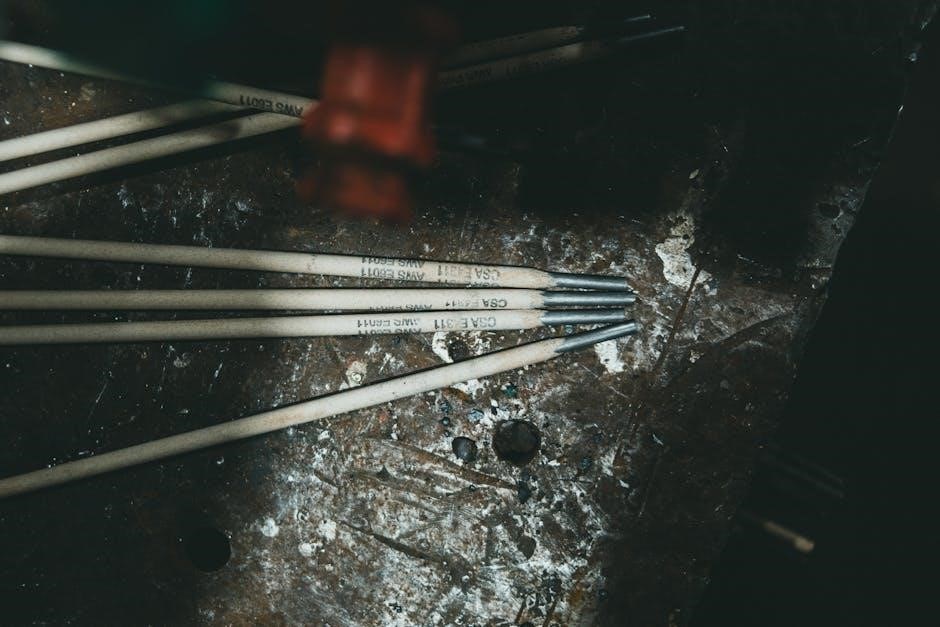
The Century FC-90 welder, a popular choice for both beginners and experienced users, offers versatility and reliability. Its manual details operation, safety, and maintenance.
What is the Century FC-90?
The Century FC-90 is a flux-cored arc welding (FCAW) machine, renowned for its user-friendly design and suitability for various projects. Often favored by hobbyists and those new to welding, the FC-90 provides a balance between affordability and performance. The welder’s manual emphasizes its capability to handle light to medium-duty tasks, including automotive repair, farm maintenance, and small fabrication jobs.
It’s a single-phase welder, typically operating on standard 120V household current, making it accessible without requiring specialized electrical setups. The manual details its core-focused operation, highlighting its simplicity compared to more complex welding processes like TIG or MIG.
Key Features and Specifications
The Century FC-90 welder manual outlines several key features. Input power is 120V, with a maximum amperage output of 85 amps. It accepts .030″ and .035″ flux-cored wire, offering versatility for different welding applications. The manual details a duty cycle of 20% at 85 amps, meaning it can weld for a limited time before needing to cool down.
Its compact and lightweight design (around 40 lbs) enhances portability. The FC-90 features simple controls for voltage adjustment, allowing users to fine-tune their welds. The manual also specifies included accessories, like a welding gun, ground clamp, and electrode holder.
Safety Precautions
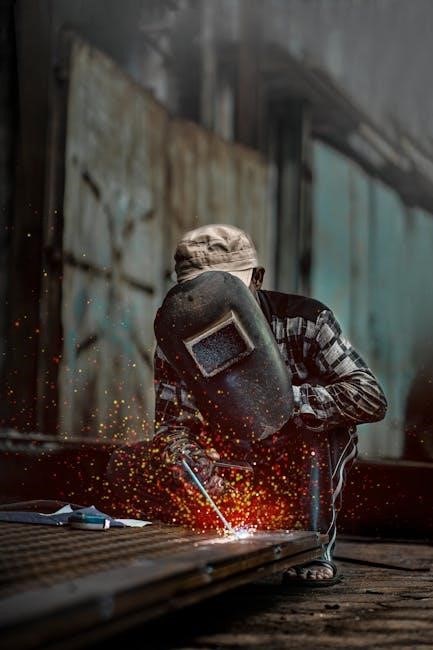
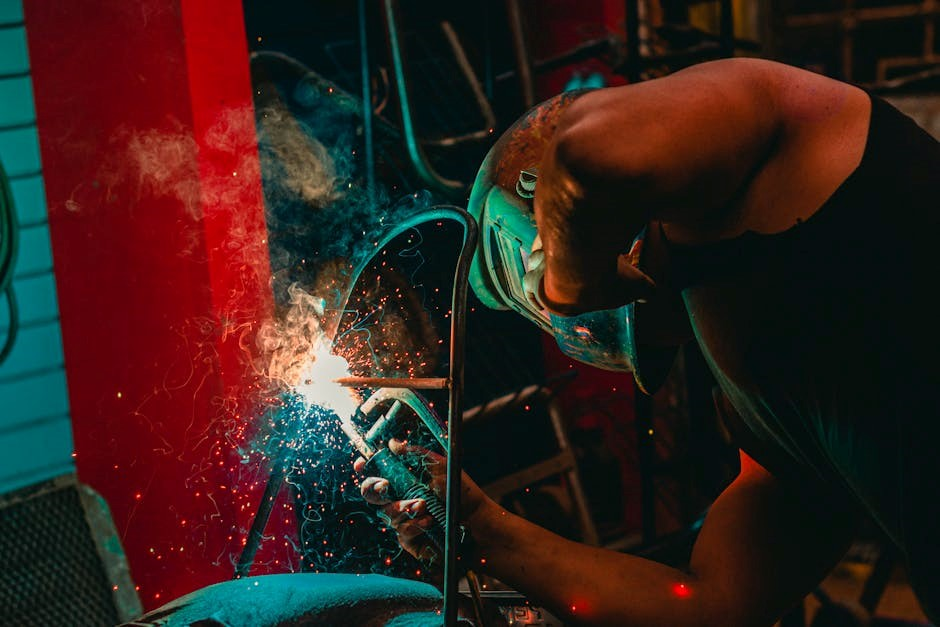
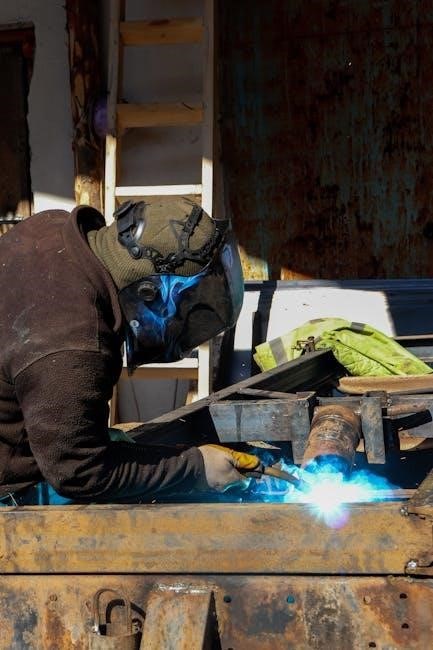
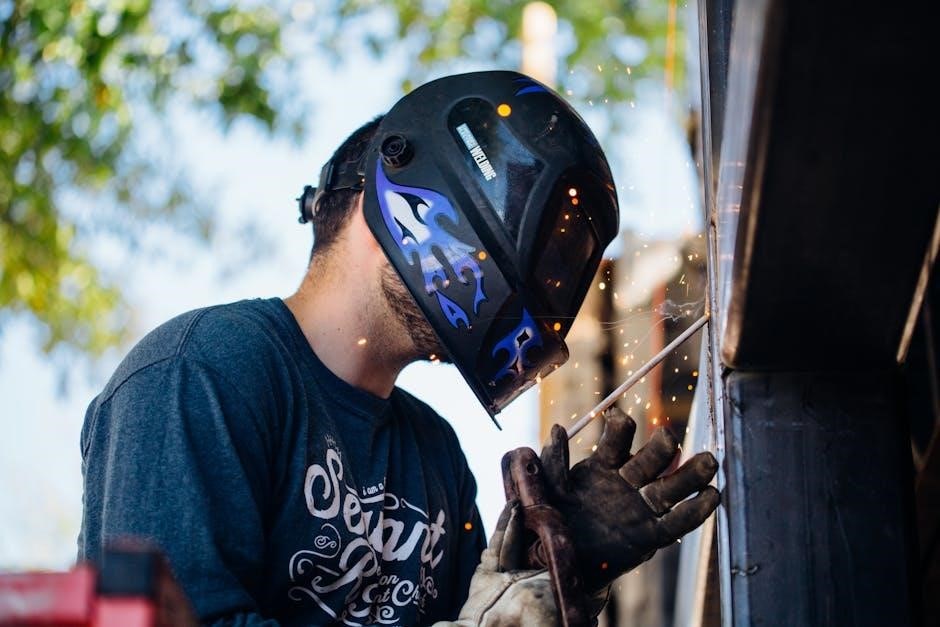
The Century FC-90 welder manual emphasizes crucial safety measures. Always wear proper PPE – including a welding helmet, gloves, and fire-resistant clothing – to prevent injuries.
General Welding Safety
The Century FC-90 welder manual stresses comprehensive safety practices. Prioritize a well-ventilated workspace to avoid fume inhalation, as welding produces potentially hazardous gases. Ensure the area is free from flammable materials; sparks and hot metal pose a significant fire risk. Always disconnect the power source before performing any maintenance or adjustments.
Proper personal protective equipment (PPE) is non-negotiable. This includes a certified welding helmet with the correct shade lens, fire-resistant clothing (leather is ideal), sturdy work boots, and welding gloves. Protect your eyes and skin from arc radiation. Be mindful of electrical hazards – never weld in damp environments or with wet gloves. Regularly inspect equipment for damage and report any issues immediately.
Specific Safety Concerns for the FC-90
The Century FC-90 welder manual highlights potential hazards unique to this model. Due to its compact size, ensure stable placement to prevent tipping during operation. Pay close attention to the duty cycle; exceeding it can lead to overheating and potential component failure. The manual cautions against modifying the unit in any way, as this voids the warranty and compromises safety.
Inspect the electrode holder and ground clamp regularly for secure connections and insulation integrity. Be aware of the potential for electromagnetic interference (EMI) from the FC-90, which could affect nearby sensitive electronic devices. Always follow the recommended amperage settings for the material being welded to avoid excessive spatter and potential burns.

Setting Up the FC-90
The Century FC-90 welder manual guides users through initial setup, emphasizing proper power source connection, secure grounding, and optional gas configuration for optimal performance.
Initial Inspection and Components
Before operating the Century FC-90, carefully inspect all components as detailed in the welder manual. Verify the machine hasn’t sustained damage during shipping. Confirm the presence of the power cable, ground clamp, electrode holder (or TIG torch/MIG gun), gas regulator (if applicable), and user manual.
Check for loose connections or frayed wires. Ensure the welding cable is in good condition, free from cracks or exposed conductors. The manual stresses the importance of a complete component inventory before first use. Familiarize yourself with each part’s function to ensure safe and efficient operation. Any missing or damaged parts should be reported immediately to Century customer support.
Power Source and Grounding
The Century FC-90 manual specifies input power requirements – typically 120V or 240V, depending on the model. Always verify your power source matches these specifications. Proper grounding is crucial for safety; connect the ground clamp to a known good earth ground.
Never remove the ground prong from the power plug. The manual details appropriate circuit breaker or fuse sizing to prevent overload. Use a dedicated circuit to avoid interference from other appliances. Incorrect grounding can lead to electric shock, so follow the manual’s instructions meticulously. Regularly inspect the ground clamp for corrosion and secure connections.
Gas Setup (If Applicable)
The Century FC-90 manual details gas setup only if your model supports gas-shielded welding, like MIG. Typically, this involves connecting a shielding gas cylinder (argon/CO2 mix is common) with a regulator and flow meter. Ensure the regulator is compatible with the gas type and cylinder valve.
The manual specifies correct gas flow rates for different materials and thicknesses. A leak test is essential – use soapy water to check connections. Improper gas flow affects weld quality, causing porosity or oxidation. Always purge the gas line before welding to remove contaminants. Follow the manual’s safety guidelines for handling gas cylinders.
Operating the FC-90
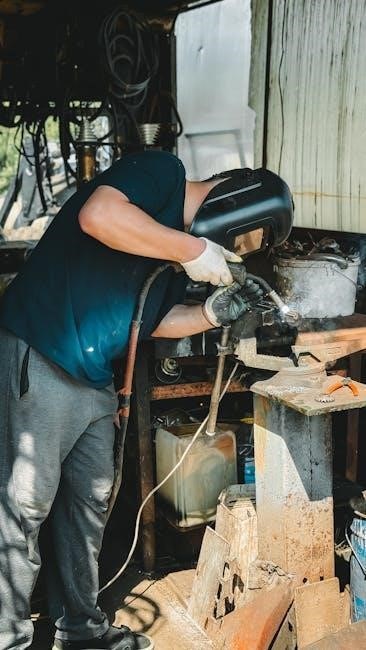
The Century FC-90 manual guides users through the control panel, voltage/amperage adjustments, and proper welding techniques for optimal results and safety.
Understanding the Control Panel
The Century FC-90’s control panel, as detailed in the welder manual, features a straightforward layout designed for ease of use. Key components include the voltage control knob, which adjusts the arc characteristics, and the amperage selector, determining the welding current.
A pilot light indicates power status, while a thermal overload indicator warns against overheating. The manual emphasizes understanding these indicators to prevent damage and ensure safe operation. Further controls may include gas flow settings (if applicable) and polarity selection switches. Properly interpreting these settings, guided by the manual, is crucial for achieving desired weld quality and material compatibility.
Adjusting Voltage and Amperage
The Century FC-90 welder manual provides detailed guidance on adjusting voltage and amperage. Voltage controls arc length and width; higher voltage creates a flatter, wider bead, while lower voltage yields a narrower, more focused arc. Amperage dictates the welding current, influencing penetration depth.
The manual recommends starting with lower settings and gradually increasing them until the desired weld pool is achieved. Material thickness is a key factor – thicker materials require higher amperage. Proper adjustment, as illustrated in the manual’s charts, prevents burn-through or insufficient fusion, ensuring strong and consistent welds.
Welding Techniques with the FC-90
The Century FC-90 welder manual details several welding techniques. For beginners, a straight bead technique is recommended, focusing on consistent travel speed and arc length; The manual illustrates proper electrode angles and manipulation for various joint types – lap, butt, and fillet.
More advanced techniques, like weaving, are explained for wider bead coverage. The manual emphasizes the importance of pre-cleaning metal surfaces and proper joint preparation. It also provides guidance on selecting the correct shielding gas and wire feed speed for optimal results, ensuring quality welds across diverse applications.
Troubleshooting Common Issues
The Century FC-90 welder manual provides solutions for typical problems like no power, arc instability, and burn back. Detailed diagrams aid diagnosis and repair.
No Power
If the Century FC-90 fails to power on, the manual instructs users to first verify the power cord connection and the circuit breaker. Check for blown fuses within the welder itself, referencing the diagram in the manual for location. Ensure the on/off switch is fully engaged.
A lack of input voltage should also be confirmed with a multimeter. The manual emphasizes checking the grounding connection, as a faulty ground can prevent operation. If these steps don’t resolve the issue, the manual advises contacting qualified service personnel for further diagnostics and repair, avoiding self-repair attempts.
Arc Instability
Arc instability with the Century FC-90, as detailed in the manual, often stems from improper grounding or a loose connection to the workpiece. The manual recommends thoroughly cleaning the metal surface to remove rust, paint, or contaminants hindering a stable arc.
Voltage and amperage settings should be adjusted according to the metal thickness and type, as outlined in the manual’s welding parameter charts. A fluttering or erratic arc can also indicate a worn electrode or incorrect polarity. The manual stresses the importance of using the correct shielding gas flow rate if applicable, and inspecting the gas nozzle for obstructions;
Burn Back Issues
Burn back, as explained in the Century FC-90 welder manual, occurs when the welding wire melts back into the contact tip during welding. The manual advises checking the wire feed tension; too little tension causes inconsistent feeding and burn back.
Incorrect voltage settings are also a common culprit – the manual suggests lowering the voltage. Ensure the correct polarity is selected for the chosen welding process. A worn or damaged contact tip should be replaced immediately, as detailed in the manual’s parts list. Finally, the manual recommends verifying proper gas coverage to shield the arc and prevent burn back.

Maintenance and Care
The Century FC-90 welder manual stresses regular cleaning, cable inspection, and proper storage. These steps ensure longevity and optimal performance of your welding machine.
Cleaning the Welder
According to the Century FC-90 welder manual, maintaining a clean machine is crucial for reliable operation. Regularly remove metal debris, dust, and grime from the exterior using a soft brush or compressed air. Avoid using solvents, as they can damage the finish. Pay particular attention to ventilation openings, ensuring they are unobstructed for proper cooling.
Internally, inspect the welding cables for corrosion or damage. Clean the cable connectors with a wire brush to ensure a good electrical connection. The manual also recommends periodically checking and cleaning the ground clamp. A clean welder operates more efficiently and reduces the risk of malfunctions, extending its lifespan considerably.
Inspecting Cables and Connections
The Century FC-90 welder manual emphasizes the importance of routinely inspecting welding cables for cracks, fraying, or damage to the insulation. Damaged cables pose a significant safety hazard. Check connections at both ends – the welder, the work clamp, and the electrode holder – for corrosion or looseness.
Ensure all connections are tight and clean, using a wire brush if necessary to remove any buildup. A poor connection can lead to voltage drop, arc instability, and overheating. Replace any damaged cables immediately. Proper cable maintenance, as detailed in the manual, guarantees safe and efficient welding performance.
Storage Recommendations
The Century FC-90 welder manual advises storing the unit in a clean, dry environment to prevent corrosion and damage. Cover the welder to protect it from dust and debris. Disconnect the power cord and ensure the welder is completely cool before storing.
Coil the welding cables neatly and store them separately to avoid tangling. Regularly check the storage area for moisture or pests. Following these storage recommendations, outlined in the manual, will prolong the lifespan of your Century FC-90 and ensure it’s ready for use when needed, maintaining optimal performance.
Advanced Techniques
The Century FC-90 welder manual explores pulse welding and material-specific settings, enhancing weld quality and control for experienced operators.
Pulse Welding with the FC-90
The Century FC-90 welder manual details pulse welding, a technique offering precise heat control and improved weld bead appearance. Pulse welding alternates between high and low current, reducing distortion and spatter. Adjusting pulse frequency and duty cycle allows customization for various materials and thicknesses.
The manual explains how to set pulse parameters for optimal results, emphasizing the benefits for thin metals and intricate welds. It also cautions against excessive heat buildup and provides troubleshooting tips for pulse-related issues. Mastering pulse welding with the FC-90 requires practice, but yields superior weld quality and control.
Welding Different Materials
The Century FC-90 welder manual provides guidance on welding various materials, including steel, stainless steel, and aluminum. It details specific settings – voltage, amperage, and wire speed – for each material type and thickness. The manual stresses the importance of using the correct shielding gas for optimal weld quality and to prevent contamination.
It also outlines preheating requirements for certain materials and warns against attempting to weld incompatible metals. Proper preparation, including cleaning and surface treatment, is emphasized. Following the manual’s recommendations ensures successful welds and extends the lifespan of the FC-90.
Century FC-90 vs. Other Welders
The Century FC-90 welder manual aids comparison; it’s a budget-friendly option, excelling in home/small shop use, though lacking features of higher-end models.
Comparison with Similar Models
Comparing the Century FC-90, referencing its manual, to similar welders reveals key distinctions. Models like the Lincoln Power MIG 210MP offer more advanced features – pulse welding, for instance – and a broader amperage range, justifying a higher price point. The Hobart 219 MVP is another competitor, known for its robust build quality and user-friendliness, though again, at a premium.
The FC-90’s strength lies in its simplicity and affordability. Its manual clearly outlines its capabilities, making it ideal for beginners or those undertaking light-duty projects. While it may not match the sophistication of pricier options, the FC-90 provides a solid entry point into the world of welding, offering good value for the investment, as detailed within its comprehensive guide.
Advantages and Disadvantages
The Century FC-90 welder, as detailed in its manual, presents distinct advantages. Its affordability and ease of use make it perfect for beginners and DIY enthusiasts. The manual’s clear instructions simplify setup and operation. Portability is another benefit, allowing for versatile project locations. However, the FC-90 has limitations.
Disadvantages include a lower duty cycle compared to more expensive models, restricting prolonged welding sessions. The amperage range is also somewhat limited, potentially hindering thicker material projects. While the manual covers troubleshooting, complex repairs may require professional assistance. Ultimately, the FC-90 excels as an entry-level machine, balancing cost-effectiveness with functional capability.
Resources and Support
The Century FC-90 welder manual is available online. Customer support can be contacted directly, and numerous online forums offer community assistance and troubleshooting.
Finding the Century FC-90 Manual Online
Locating the Century FC-90 welder manual is straightforward in today’s digital age. A comprehensive search on the manufacturer’s official website is the primary recommendation. Often, a dedicated “Support” or “Resources” section houses downloadable manuals in PDF format.
Alternatively, several third-party websites specialize in archiving manuals for various tools and equipment, including welding machines. These sites can be accessed through a general web search. Be cautious when downloading from unofficial sources to ensure the manual is legitimate and free of malware.
Always verify the manual’s version corresponds to your specific FC-90 model, as updates and revisions may occur over time. Having the correct manual is crucial for safe and effective operation.
Contacting Century Customer Support
For direct assistance with your Century FC-90 welder, reaching out to Century’s customer support is a valuable option. Their official website typically provides contact information, including a phone number and email address. Expect potentially longer wait times during peak hours or promotional periods.
When contacting support, have your welder’s model number and serial number readily available. This allows representatives to quickly access specific information related to your machine. Clearly articulate your issue or question, referencing the manual if applicable.
Detailed descriptions and, if possible, photos or videos of the problem can expedite the troubleshooting process. Be prepared to follow their guidance and potentially provide further details as requested.
Online Forums and Communities
Numerous online forums and welding communities offer a wealth of information and support for Century FC-90 welder owners. These platforms provide a space to connect with fellow enthusiasts, share experiences, and seek advice on troubleshooting issues or understanding the manual.
Popular welding forums often have dedicated sections for specific welder brands, including Century. Search for threads related to the FC-90 model to find discussions relevant to your needs. Remember to verify information shared by other users.
Active communities can be invaluable for learning advanced techniques and discovering helpful tips not always found in the official documentation.
Understanding Welding Terminology
Key terms like voltage, amperage, and duty cycle are crucial for operating the Century FC-90. The welder manual explains these concepts for optimal performance.
Voltage, Amperage, and Duty Cycle
Understanding these three elements is fundamental to successful welding with the Century FC-90. Voltage, measured in volts, dictates the arc length and penetration. Amperage, in amps, controls the weld’s heat input and deposition rate – the manual provides charts for material thickness.
Duty cycle, expressed as a percentage, signifies how long the welder can operate at a given amperage before overheating. The FC-90 manual details specific duty cycles for various settings. Exceeding the duty cycle risks damage. Proper adjustment of these parameters, guided by the manual, ensures strong, clean welds and prolongs the welder’s lifespan.
Different Welding Processes (MIG, TIG, Stick)
The Century FC-90 welder primarily supports Stick (SMAW) welding, detailed extensively within its manual. While not natively equipped for MIG or TIG, understanding these processes provides context; MIG (GMAW) uses a continuously fed wire electrode, offering faster welding speeds. TIG (GTAW) employs a non-consumable tungsten electrode, providing precise control.
The manual clarifies the FC-90’s limitations regarding these alternative methods. Adapting the FC-90 for MIG or TIG would require significant modifications and is generally not recommended. Focusing on mastering Stick welding, as outlined in the manual, yields the best results with this machine.
The History of Century Welders
Century Welders boasts a long tradition of innovation in arc welding technology. The FC-90’s manual reflects decades of experience, offering reliable performance and user-friendly operation.
Century’s Role in Welding Technology
Century Welders has been a significant contributor to the advancement of welding techniques for many years, consistently providing robust and accessible equipment. Their commitment to quality is evident in products like the FC-90, and meticulously documented within its comprehensive manual. This manual isn’t just instructions; it’s a distillation of accumulated knowledge.
Century’s history demonstrates a dedication to meeting the evolving needs of both professional welders and DIY enthusiasts. The FC-90 manual exemplifies this, offering clear guidance on setup, operation, and troubleshooting. It reflects a legacy of empowering users with the tools and information needed to achieve successful welding results, solidifying Century’s position as a trusted name in the industry.
Evolution of the FC-90 Model
The Century FC-90 welder hasn’t remained static; it’s undergone refinements over time, documented in updated versions of its accompanying manual. Early iterations focused on core functionality, while later models incorporated user feedback and technological advancements. The manual reflects these changes, providing clarity on new features and improved operational procedures.
Each revision of the FC-90 and its manual aimed to enhance usability and address common welding challenges. Improvements in control panel design, amperage settings, and safety features are all detailed within. The current manual serves as a testament to Century’s commitment to continuous improvement, ensuring the FC-90 remains a relevant and reliable welding solution.